

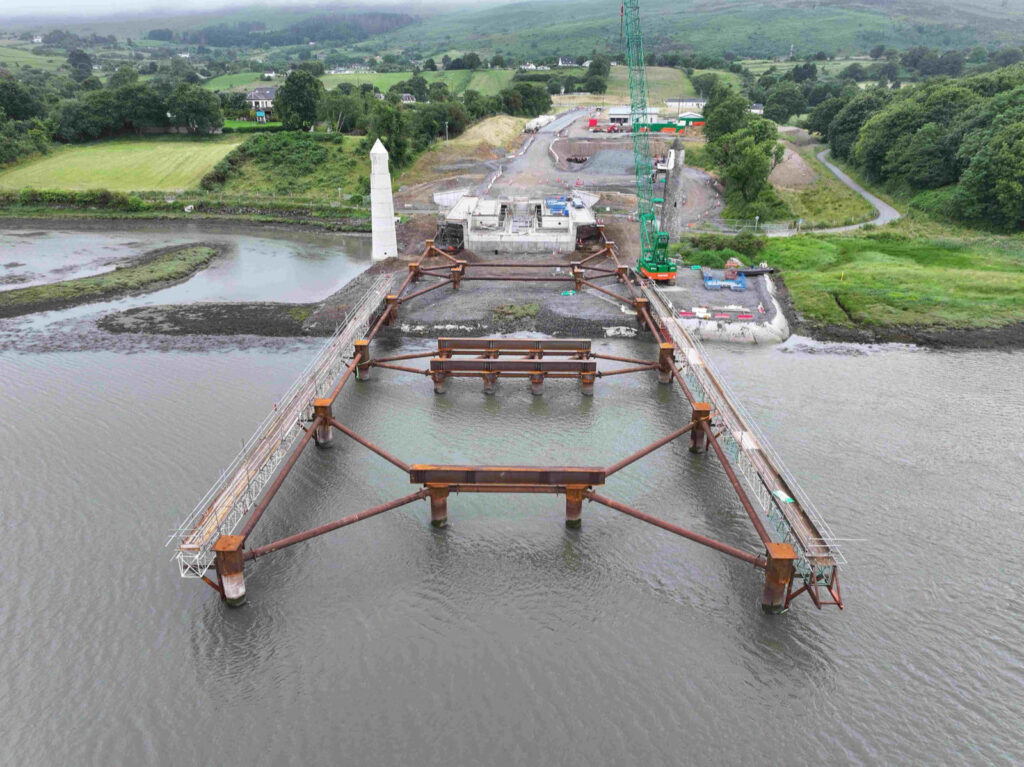
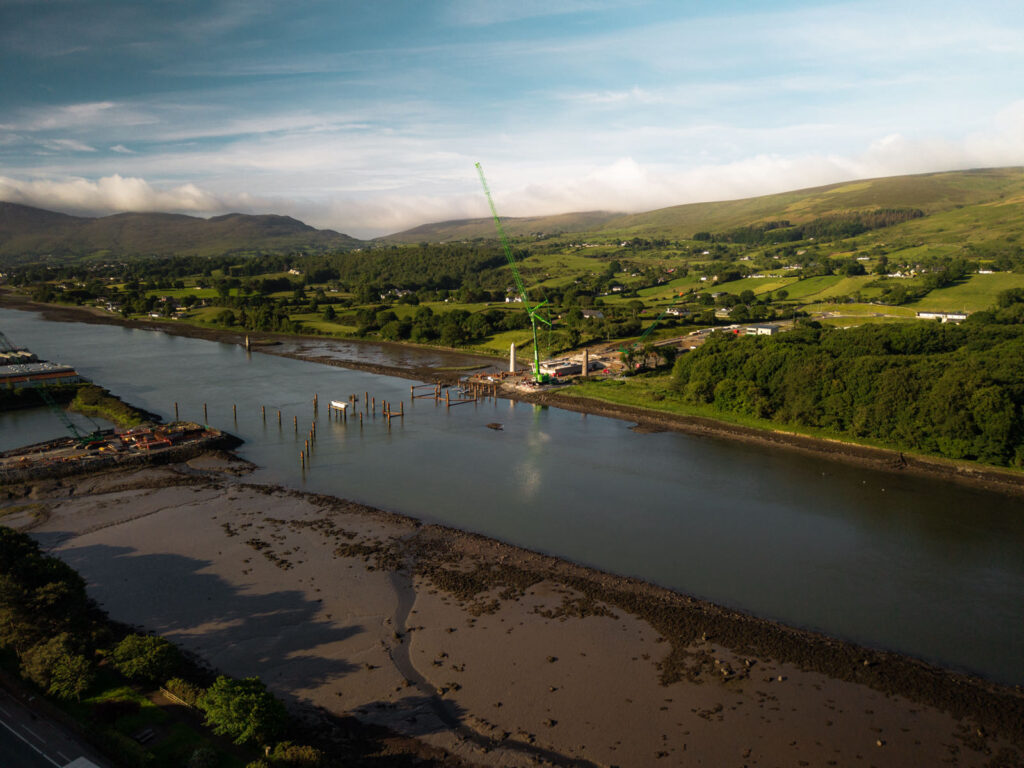
A key milestone has been reached in the construction of the €102 million Narrow Water Bridge, with temporary structures designed by Belfast’s AM Consulting Engineers (AMCE) now extending into the River Newry from both banks. For the first time, passersby can now get a sense of how the long-awaited bridge will eventually span the river, as two new 65m structures extend from each bank into the River Newry. Led by the main contractor BAM Ireland, the work marks a significant engineering achievement on the transformative cross-border infrastructure project connecting Counties Down and Louth.
AM Consulting Engineers is proud to deliver a major milestone on the €102m Narrow Water Bridge
A key construction milestone has been achieved on the €102 million Narrow Water Bridge project with the installation of the fixed span skid track in the River Newry. Led by the main contractor BAM Ireland, the work marks a significant engineering advancement on the transformative cross-border infrastructure project connecting Counties Down and Louth.
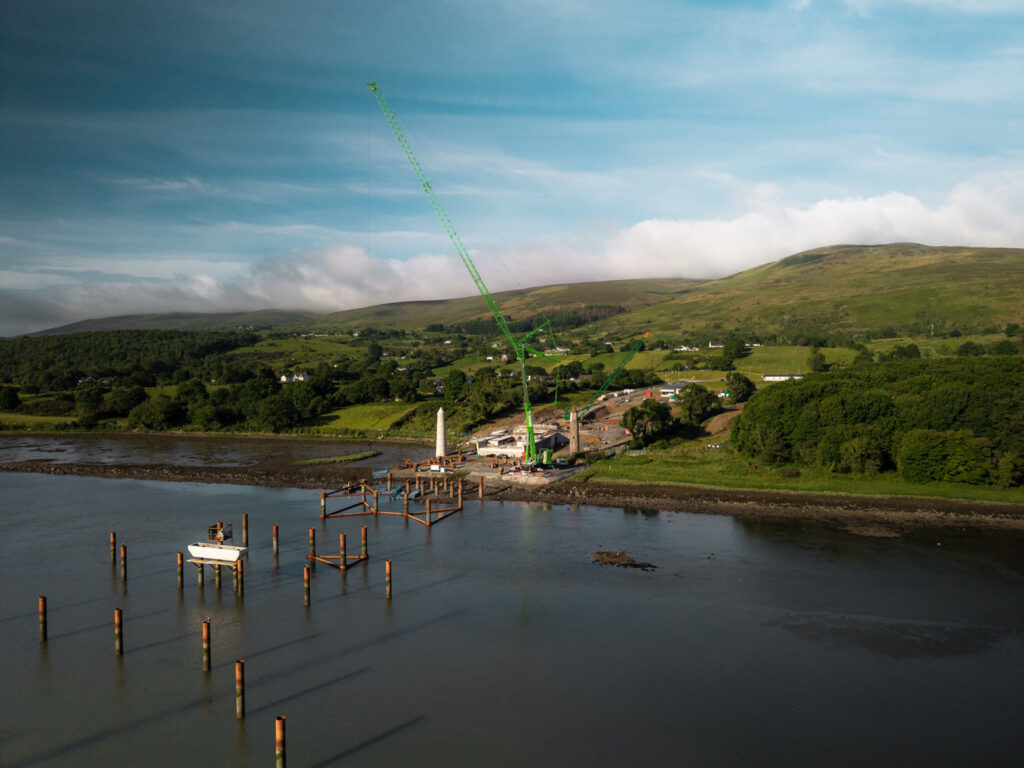
Designed by Belfast-headquartered AM Consulting Engineers (AMCE), which acquired Midlands-based Bridges Pound Ltd earlier this year, the newly installed temporary works consist of a 155-tonne steel-beam skid-track system extending 130m from the barge delivery position within the Newry River to the south abutment of the Narrow Water Bridge.
Fabricated by Jamestown Manufacturing in County Laois, the skid track is supported by a series of temporary steel piles also designed by AMCE and installed by Quinn Piling Limited from Co Down. The structure will play a critical role in enabling the installation of three bridge sections, fabricated in Belgium by Aelterman BV and installed by Sarens.
138m cable-stayed deck
Once complete, the Narrow Water Bridge will comprise a 138-metre cable-stayed deck, a 98.6-metre pylon, and a 56-metre opening span across the navigable channel of the River Newry, allowing boats to pass through.
AMCE’s temporary works have been specifically engineered to facilitate the installation of the three fixed span sections consisting of the two main bridge deck sections and the pylon. The sections and pylon, which weigh a combined 2245 tonnes, will arrive at Warrenpoint Harbour by barge from Belgium before being transported upriver. They will then be transferred onto the bespoke skid track system and slid into their final position, where they will be supported by AMCE’s temporary supports prior to final connection and cable stay stressing.
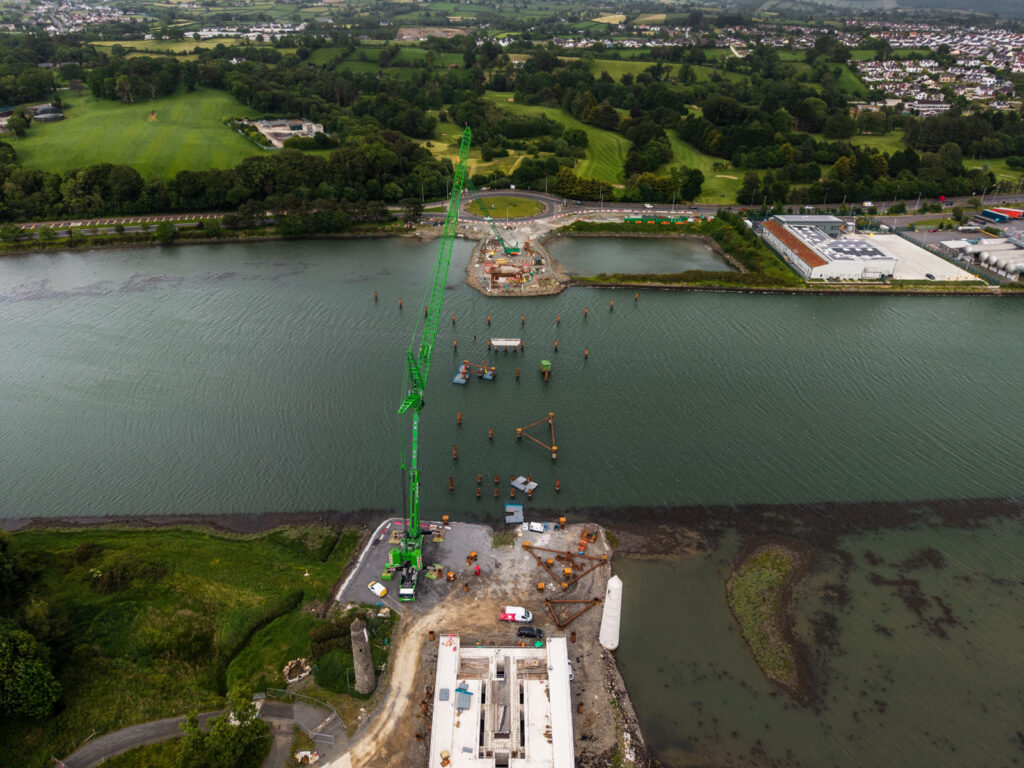
The Narrow Water Bridge is a flagship initiative under the Shared Island Fund and has been designed to accommodate vehicles, cyclists, and pedestrians. The bridge will also feature a movable bascule span to allow maritime access to the Newry Canal. It is being delivered by Louth County Council in partnership with the Department of Housing, Local Government and Heritage and the Shared Island Initiative, with BAM UK & Ireland acting as main contractor.
Speaking about completion of the first visible span across the River Newry, John Lucy, Director of Civil Engineering from main contractor BAM, said: “The construction of the Narrow Water Bridge over the River Newry is a complex and challenging project. It requires careful planning and coordination and can only be successfully delivered with engineering excellence and collaboration. AM Consulting Engineers have been a key delivery partner, and their temporary works design capability has been integral to constructing critical elements of the bridge installation infrastructure. We are extremely pleased with the progress made so far on this project, and we look forward to the next stage of this transformative development.”
Sustainability
Revealing some of the challenges on the project, Ryan Todd, Associate at AMCE, said: “We’ve devised a framework consisting of an overall steel weight of around 155 tonnes, excluding the piles. We needed the structure to support not only the dead load of the bridge sections but also accommodate a wide range of operational loads, including deck loads, wind loads, tidal forces, mooring loads and, critically, braking forces as the bridge sections are moved across the framework.
“We’ve got enormous deck loads, with the pylon alone weighing 870 tonnes and total loads across the structure reaching 2245 tonnes, so there were lots of factors that must be carefully considered in the design and execution of our temporary works.
“In addition, to minimise the amount of steel used, we examined how the temporary works could interact with the permanent abutments already in place. The challenge was achieving the necessary performance while maintaining buildability and controlling the significant forces being transferred through the structure. It was difficult to get those connections to work because the forces are so high and the structure is so sensitive that even a minor change meant you were constantly in pass-or-fail mode.
“We were in constant discussion with the team at BAM to see how we could make things work sustainably that are also cost-effective, but together we got there, and we’re delighted to see things continuing to move at pace on the project.”
Geotech challenges
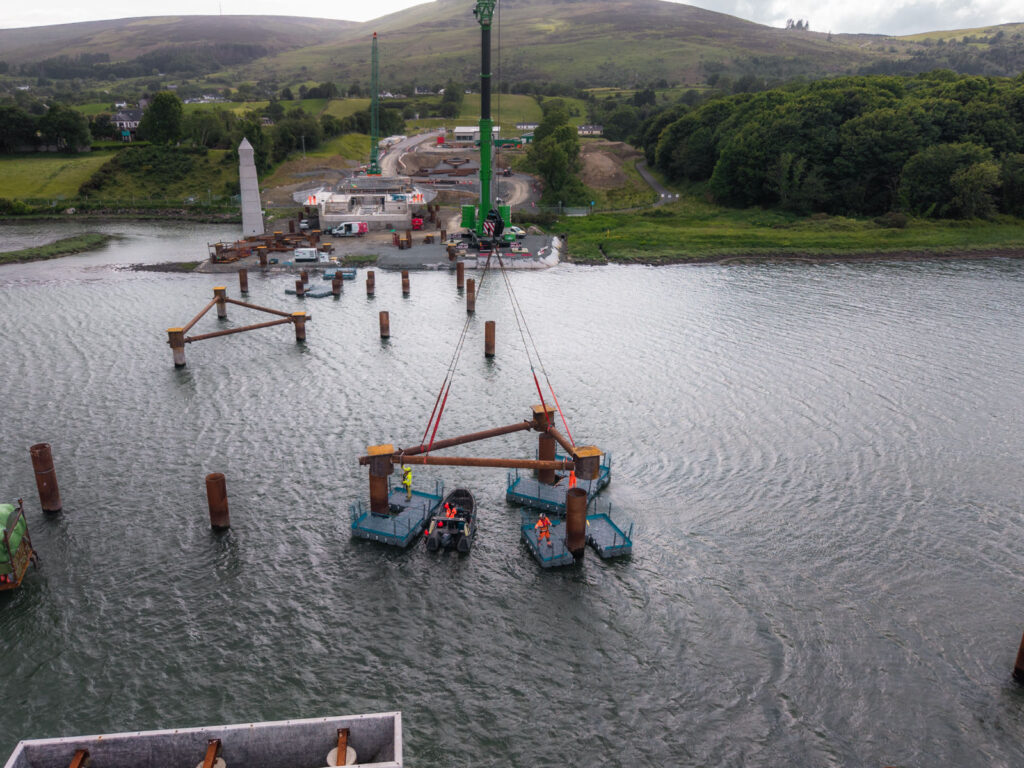
The geotechnical design of the temporary works also posed significant engineering challenges due to highly variable ground conditions and construction constraints.
Speaking about how the project highlighted the importance of integrating geotechnical and structural engineering disciplines from the earliest design stages of the project, AMCE’s Technical Director, Chris Chapman, added: “Projects of this complexity highlight the importance of integrating geotechnical and structural engineering from the outset. Understanding the varying ground conditions early allowed our design team to develop more efficient and sustainable foundation solutions and gave our contractors greater certainty during construction.
“There were a number of key insights which fed in along the way. We found significant variation in the riverbed topography along the alignment, resulting in progressively increasing pile-free lengths above bed level and higher structural demands within the pile sections.
“This was addressed through the introduction of an additional low-level propping frame within the deepest section of the river, providing restraint to the piles and reducing their effective unsupported length during installation and bridge erection.
“Alongside this, uncertainty surrounding rock socket performance was reduced through back-analysis of adjacent permanent abutment pile load tests. This enabled refinement of the geotechnical design parameters and increased confidence in the assumed shaft resistance and socket behaviour adopted for the temporary works configuration. To mobilise reliable base resistance, a concrete base plug was incorporated to ensure adequate end-bearing performance within the pile sockets.”
Structural supports
Following installation of the bridge sections, the temporary works will continue to support the structures while permanent activities, including concrete pours and cable stay installation, are completed. Once the cable stay system has been tensioned, the decks will be lifted into their final positions and the temporary works progressively removed.
Speaking about the team’s work on the project, Paul McGreevy, Director of Structures at AM Consulting Engineers, said: “While the finished permanent bridge will deservedly attract most of the attention, we’re proud that it’s our temporary works design that will have made its final installation possible. That’s no small feat, and as a local company, we’re proud to have the technical expertise in-house, working alongside the team at BAM, to deliver such a crucial part of this landmark project, which is going to transform daily life for so many.”
Commending the team at AMCE, its founder, Aidan McCarthy, added, “This significant temporary structure on the River Newry is a clear visual representation of the critical role specialist temporary works and geotechnical engineering have to play in the successful delivery of major infrastructure projects.
“Projects like Narrow Water demonstrate that successful infrastructure delivery depends on much more than the permanent structure. Our team at AM Consulting Engineers has not only demonstrated its technical expertise with regard to large-scale and complex temporary works but also played a vital role in delivering a bridge that will serve communities on both sides of the border for generations.”
Updates on the Narrow Water Bridge Project are available at www.narrowwaterbridge.com and further information on AM Consulting Engineers can be found online at www.amceltd.com
Aidan McCarthy, MD, and Paul McGreevy, Director of Structures at AM Consulting Engineers are available for interview. Please contact Lisa McElroy to arrange. Tel +44(0)7565 816 643 or email Lisa@Theprangel.com